![]() |
![]() |
||
![]() |
![]() |
||
Home > Directory Home > Drawing Lessons > Art Principles & Elements > Element of Movement
ELEMENT of MOVEMENT IN ART & DESIGN COMPOSITION : Use Repetition, Rhythm, & Action to Create Unity in Your Drawings
|
|
Composition in Art Part 2 : Eye Movement
Movement is one of the essential principles of art. Most, if not all of the eight principles of art deal greatly on composition. If you want stronger compositions, study the principles of art.
The act or process of moving, especially change of place or position, an effort. This can either be actual motion or it can be implied — the arrangement of the parts of an image to create a sense of motion by using lines, shapes, forms, and textures that cause the eye to move over the work.
Artists will rely on many tools to establish the story as well as the 'flow' of the composition from one area to another. They use a visual sense of motion through the work to create this movement. Principles of Design : Movement
Live figures portrayed in unstable body positions cause us to feel that motion is imminent. We know from past experience with these positions that some kind of movement will occur. This heightens the feeling of motion. Principles and Elements of Art : Line as Element
Simple single lines amassed in intriguing movements across a page can be a very rich drawing, full of intricate rivelets of various sizes and curvilinear swings which surprise and please the eye.
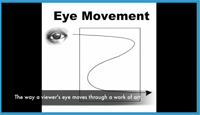
principle of movementMovement is the path our eyes follow when we look at a work of art. The purpose of movement is to create unity in the artwork with eye travel. This can be achieved by using repetition, rhythm, and action. Movement ties the work together by relating the various components of a work together. Visual Elements and Principles : Rhythm and Movement
Artists repeat shapes, colors, lines, spaces and/or textures to create movement in a composition. The easiest way to understand rhythm in a work of art is to look at a three-dimensional sculpture that actually moves in space. Changes in air currents move the repeated shapes in this sculpture to form new compositions. How to Teach the Art Elements of Line and Movement to Kids - The presence of movement in an image can change it from just a picture to a work of art. Children are usually quite capable of creating static drawings, but when it comes to creating a sense of motion, they stumble. An easy way to teach students to imbibe their image with movement is to show them how to convey movement through the use of lines. With flowing, well-placed lines, students can create captivating, dynamic images. Movement in Art Lesson Plan - By studying how Rodin portrays movement, students will experiment with the depiction of motion through various mediums. Road Trip, Line, Pattern and Movement - Students will identify and use different kinds of line and color to create patterns and movement in an artwork. They will create a visual “road trip" using Foohy® Gel Markers and Foohy® Double Ended Markers (metallic end) on colored construction paper. Elements of Unity in Painting Design
Learn how unity is used as a basic element of painting design in this free instructional video art lesson. |