


Home > Directory Home > Drawing Lessons > Nature Drawing > How to Draw Outdoor Objects Like Water, Rock, Clouds
HOW TO DRAW OUTDOOR OBJECTS FOUND IN NATURE : Drawing Rain, Rocks, Water, Clouds, Puddles and More
|


|
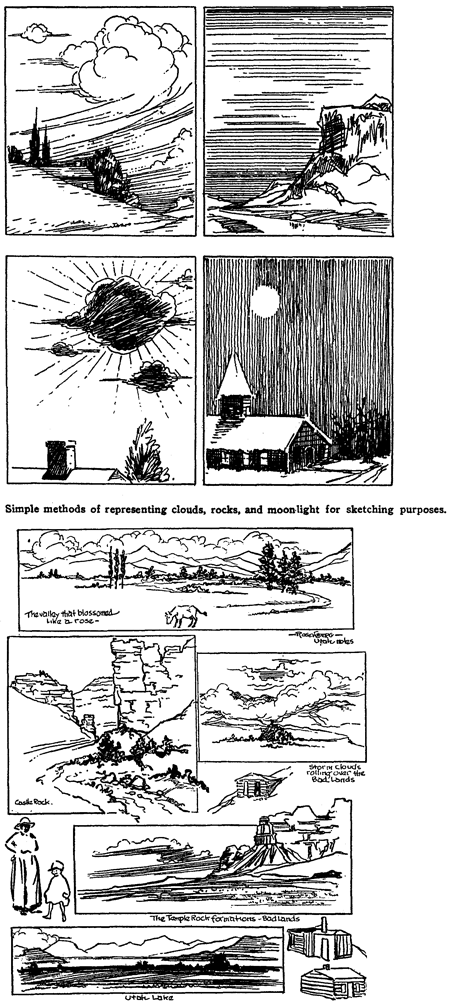
DRAWING OUTDOOR OBJECTS : Water, Rock and CloudsA knowledge of the simpler technical principles involved in drawing clouds, water, and other natural features of the outdoors, is as essential to the newspaper artist as it is to the painter, in order to give naturalness to his pictures. In drawing rocks, for example, one must be careful lest his lines tend to suggest either a wooden or a metallic formation. In order to avoid a wooden effect, it is well not to use cross-hatching, except where a very dark shadow is to be shown. The straight and more or less vertical line is perhaps easiest and best for suggesting tone line. The top ends of these lines may be shown heavier, breaking off at the bottom ends in disappearing dots. The line may be well shown slightly diagonal and varied to suggest change in the rock formation. These lines should follow the trend of the rock's surface. A dot or spatter may be effectively used to suggest shadows and tones. Also a grained paper that will permit the use of crayon is an excellent surface to indicate rock tone and effect. A sketchy, irregular line should be used to suggest large crag and peak formation in a mountain scene. In sketching a valley scene from a hill top the perspective trends upward, because the horizon line, which is ever on the level with your eyes, is even with the height you draw from. Thus the winding streams and roadway, housetops, etc., will trend upward in perspective. The hill tops on a higher plane, and the square objects thereon, will send their regular lines downward. Thus your drawing could have its horizontal center anywhere in the picture, in accord with your composition. That is, if the valley is shown mostly, the horizon line will be correspondingly nearer to the top of the picture. Should the higher hills be depicted to greater advantage, the horizon line would be lowered accordingly. And in either case all perpendicular lines should remain perpendicular. The artist working with a pen invariably finds a clear blue sky to be a blank mass. The sky that is partly hidden by clouds presents a better picture for drawing. In this respect clouds are like a beard, or mustache on a man's face—they add character, rendering it more interesting, at least from the standpoint of an artist. When you observe a bright blue sky on a clear day, you will find, particularly at an open area like an ocean or large lake front, an open field or low mountain scene, that the sky directly overhead seems a lighter blue than the sky in the distance. Toward the horizon line it gradually becomes somewhat darker.
Such a sky can either be represented by leaving it blank, or by putting color into it by means of a few lines near the horizon line. These lines are best drawn straight, or slightly semi-circular, running horizontally across the paper. They need not be of equal length—rather beginning and ending irregularly. Add a few birds in flight to suggest life and a feeling of vastness to your blank sky. A cold, gray sky can be shown by drawing straight or slightly rolling lines horizontally across the sky space, in an even tone, or gradually darker toward the top of the paper—the sky overhead. The sun at the period of the year when we have gray skies is then not overhead but instead is shining upon us from an angle. Thus the place of darker tone is shifted. Another method of showing a cold gray sky, is to draw the lines slightly wavy, perpendicularly down the sky-space of your paper. This perpendicular - line method is also the one preferred in depicting a moon-lit sky. Here again the sky is darker in the distance, lending a feeling of greater depth to the scene. But in a decorative illustration this gradual darkening towards the horizon is not necessary; in fact, it is preferable to make the tone fairly even. Another method, one easily handled in drawing a dark sky at night, is to make it solid black. Put the stars in with brush-touches of Chinese white, at random. Or in blackening the sky allow specks of white to remain, suggesting stars. There is rarely a clear blue sky that has not a wisp of fair-weather clouds strung along the horizon line, or floating there. This can be suggested by a single graceful line, half-circling along the length of and near the horizon line.
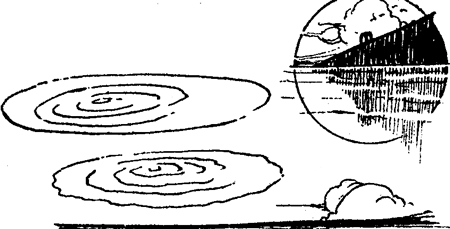
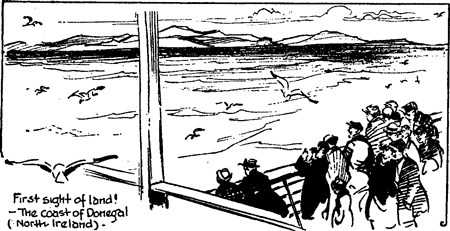
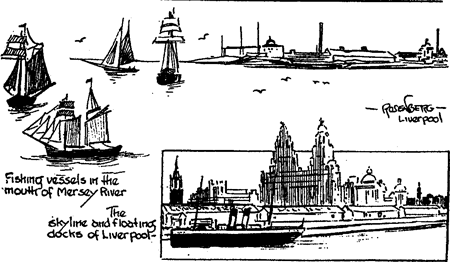
DRAWING CLOUDSClouds can be formed in many ways, for there are many varieties. The best for decorative design is the storm cloud, or "cumulus." Draw this cloud with an irregular, piled-up mass of circles, like bubbles, minus the lower portion of the circle, or not quite completely showing that part. You may add also a few lines darting out somewhat horizontally from the side of the cloud banks or beneath the circle formations at the base. Lines may be drawn across the sky, either beneath or above, though preferably beneath the rolling cloud banks, to act as a tapering medium with the vanishing base of the large cloud banks. These lines can be made to form horizontal or diagonal, rugged strata of clouds, adrift from the major formation. Now, to suggest a cloud with a silver lining: draw a cloud of large formation, preferably the, decorative cumulus. It is the reflection of the sun behind the cloud that gives it the silver lining. The cloud proper, except for the thin rim around the edge, is toned darker, since this side is in shadow, and only the edge of the vapory mass—the lining--is light. Then draw rays, darting irregularly from the top and sides of the clouds, as also from the lower side, if the cloud is floating high in the open sky. These rays can be suggested by dashing an ordinary pen line out here and there, as you would the spokes of a wheel, though not with the same regularity. Also break these lines at the edges. This makes them seem to vanish. To give the effect of a dark mass of storm clouds, draw the contour (outlines) of the major clouds, with large irregularly outlined circles. Tone these clouds dark gray, or black. Brighten the tones near the clouds' edges, especially where the sky is visible, for there the cloud is lighter in tone, usually due to the sun's reflection. The middle, the sides, and the top of the formation may catch a few light spots, here and there, a tone or so lighter than the surrounding points. These random touches, or "high spots," relieve the appearance of flatness in a dark bank of clouds. The desert cloud is more of the streaked type—fiery appearing, reddish, suggestive of heat. If the sky is completely obscured by a coat of gray clouds, this condition can be shown by drawing a tone with lines running horizontally or perpendicularly—the former are best—across the sky-section of the picture. These lines can be made heavy for a dark coat of clouds, thinner for a light one. These lines can be drawn either straight or a bit wavy. The wavy lines offer better opportunity for suggesting variations in cloud formation, by a more pronounced undulation here and there. DRAWING WATERWater is a difficult subject for the beginner to draw, since it has many forms which have to be rendered on paper. Raindrops are shaped like inverted exclamation marks, rounded at their broad base. When a shower is to be shown a broken series of irregular lines slanting usually towards the lower left corner, will suggest rain. The wind affects the slant of falling water, and should the scene be one wherein a strong wind is to be suggested, the lines may be made almost horizontal. Methods of drawing bodies of water vary according to their location and turbulence. Where lakes are surrounded completely by mountains, the water is usually clear and placid. Such a body of water should reflect, clearly, its surroundings, like a mirror. To suggest this, draw the reflection of the mountain (how much of it would depend upon your view) and the slope of the mountain. With a brush stroke or two of Chinese white, dash along with an irregular sweep, over what you would feel to be the surface of the lake. Thus you obliterate (in the reproduction it shows best) a portion of the reflection that would appear naturally in the scene, and produce an effect of a streak of light across a placid or disturbed part of the water's surface. It is well to draw your reflection with all lines running directly downward. Avoid outlining objects in the reflection. The downward lines also suggest depth, and crossing over it with Chinese white does not tend to disturb this general effect of the lines. Reflections in the water are usually lighter than the original object. Disturbed river waters, flowing swiftly, are shown by irregular, wavy lines running in the direction of and suggesting the current. Do not use too many; a few here and there will do. It is not well to make these lines heavy and coarse; having them somewhat varied and broken will give a better effect. A large inland sea or an ocean body can be handled with a mixture of crayon and brush, in addition to the pen. Hold the pencil, pen or brush far back and sketch in the action lines representing the waves, using a swinging arm movement rather than the fingers. The water crests—the waves—are shown as irregular in shape, like rows of small "i's." For a comic-cartoon suggestion of waves I often use merely a series of lines similar to connected groups of "i's."
|


Privacy Policy ..... Contact Us