STUDY OF COLORS
A consideration of the value of color study, the selection and recognition of the six positive (or standard) spectrum colors, twelve intermediate hues of the spectrum, and the naming and recognition of the same.
From an esthetic, a utilitarian, and an educational standpoint, and particularly in connection with the study of form.
In vision, color and form are the principal factors ; in truth, they are all, if we consider light and shade as a part of color. Outline, so called, is simply the edge of one mass of color against another ; or, in other words, the outline is defined by the juxtaposition of colors, or by one color being relieved against another.
There have been many disputes concerning standards of color. It is now generally accepted that the solar spectrum, " nature's standard of color," must be ours. From the numerous colors composing the spectrum, the following six, viz., red, orange, yellow, green, blue, and violet, are selected as the positive or principal spectrum colors.
Red, orange, and yellow, and combinations of the same, are classed as warm colors ; blue, green, and violet are classed as cool colors
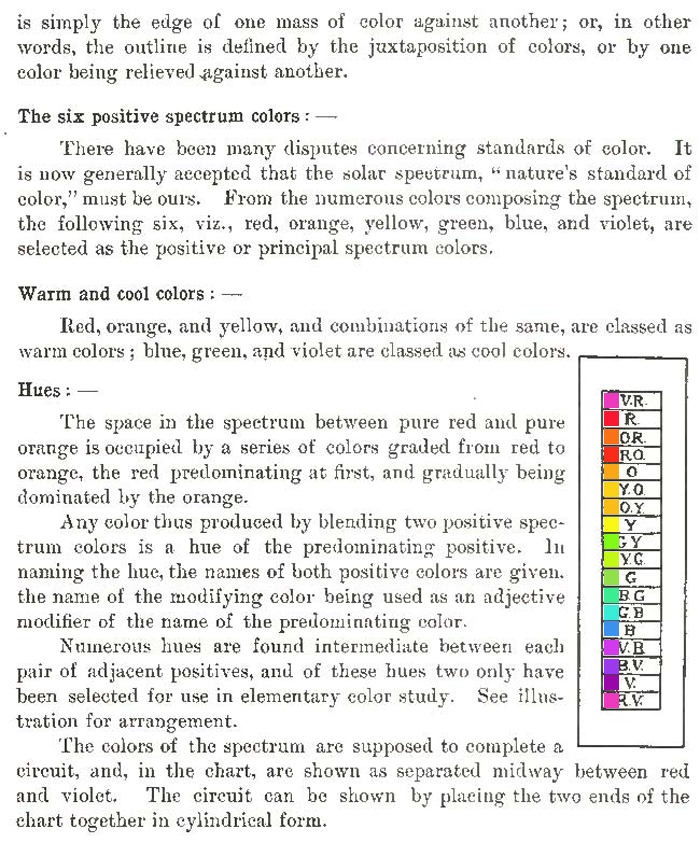
The space in the spectrum between pure red and pure orange is occupied by a series of colors graded from red to orange, the red predominating at first, and gradually being dominated by the orange.
Any color thus produced by blending two positive spectrum colors is a hue of the predominating positive. In naming the hue, the names of both positive colors are given, the name of the modifying color being used as an adjective modifier of the name of the predominating color.
Numerous hues are found intermediate between each pair of adjacent positives, and of these hues two only have been selected for use in elementary color study. See illustration for arrangement.
The colors of the spectrum are supposed to complete a circuit, and, in the chart, are shown as separated midway between red and violet. The circuit can be shown by placing the two ends of the chart together in cylindrical form.
The study of tints and shades, and their arrangement in scales; also of neutrals, broken colors, and grays.
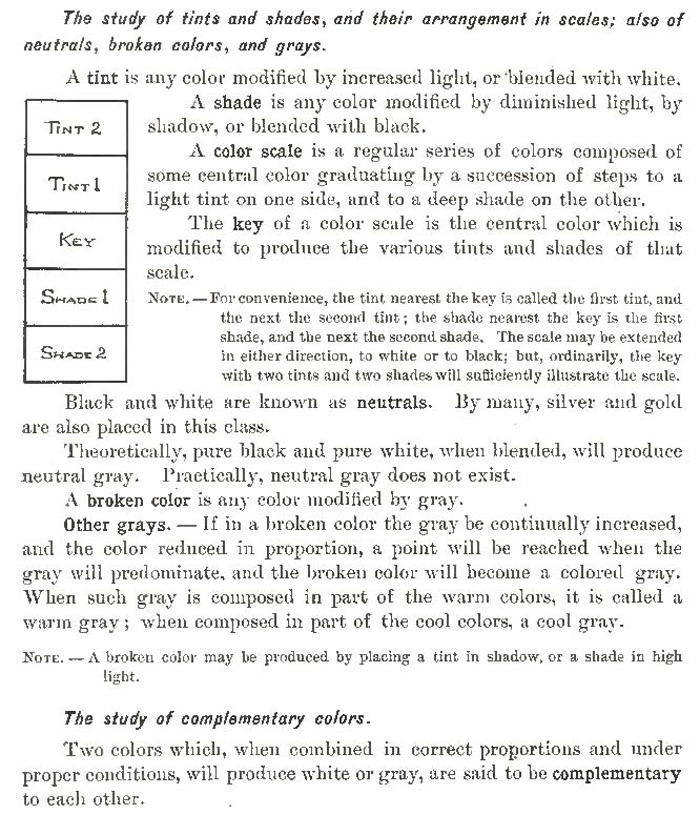
A tint is any color modified by increased light, or 'blended with white. A shade is any color modified by diminished light, by shadow, or blended with black.
A color scale is a regular series of colors composed of some central color graduating by a succession of steps to a light tint on one side, and to a deep shade on the other.
The key of a color scale is the central color which is modified to produce the various tints and shades of that scale.
NOTE. —For convenience, the tint nearest the key is called the first tint, and the next the second tint ; the shade nearest the key is the first shade, and the next the second shade. The scale may be extended in either direction, to white or to black; but, ordinarily, the key with two tints and two shades will sufficiently illustrate the scale.
Black and white are known as neutrals. By many, silver and gold are also placed in this class.
Theoretically, pure black and pure white, when blended, will produce neutral gray. Practically, neutral gray does not exist.
A broken color is any color modified by gray.
Other grays. — If in a broken color the gray be continually increased, and the color reduced in proportion, a point will be reached when the gray will predominate, and the broken color will become a colored gray. When such gray is composed in part of the warm colors, it is called a warm gray ; when composed in part of the cool colors, a cool gray.
NOTE. — A broken color may be produced by placing a tint in shadow, or a shade in high light.
The study of complementary colors.
Two colors which, when combined in correct proportions and under proper conditions, will produce white or gray, are said to be complementary to each other.
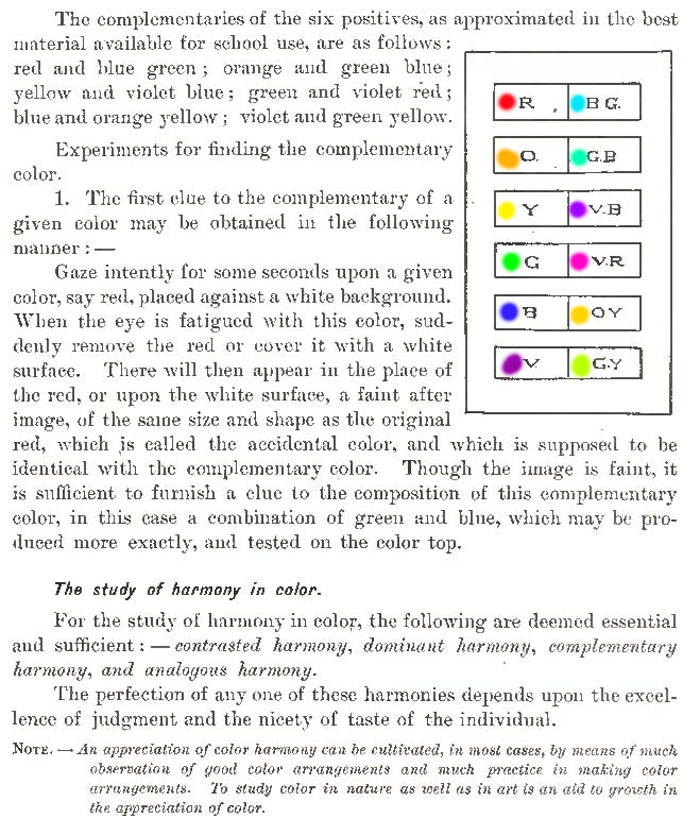
The complementaries of the six positives, as approximated in the best material available for school use, are as follows : red and blue green ; orange and green blue ; yellow and violet blue ; green and violet red ; blue and orange yellow ; violet and green yellow.
1. The first clue to the complementary of a given color may be obtained in the following manner : —
Gaze intently for some seconds upon a given color, say red, placed against a white background. When the eye is fatigued with this color, suddenly remove the red or cover it with a white surface. There will then appear in the place of the red, or upon the white surface, a faint. after image, of the same size and shape as the original red, which is called the accidental color, and which is supposed to be identical with the complementary color. Though the image is faint, it is sufficient to furnish a clue to the composition of this complementary color, in this case a combination of green and blue, which may be produced more exactly, and tested on the color top.
For the study of harmony in color, the following are deemed essential and sufficient : — contrasted harmony, dominant harmony, complementary harmony, and analogous harmony.
The perfection of any one of these harmonies depends upon the excellence of judgment and the nicety of taste of the individual.
NOTE. —An appreciation of color harmony can be cultivated, in most cases, by means of much observation of good color arrangements and much practice in making color arrangements. To study color in nature as well as in art is an aid to growth in the appreciation of color.
Contrasted harmony is the effect produced by placing any color in contrast with gray.
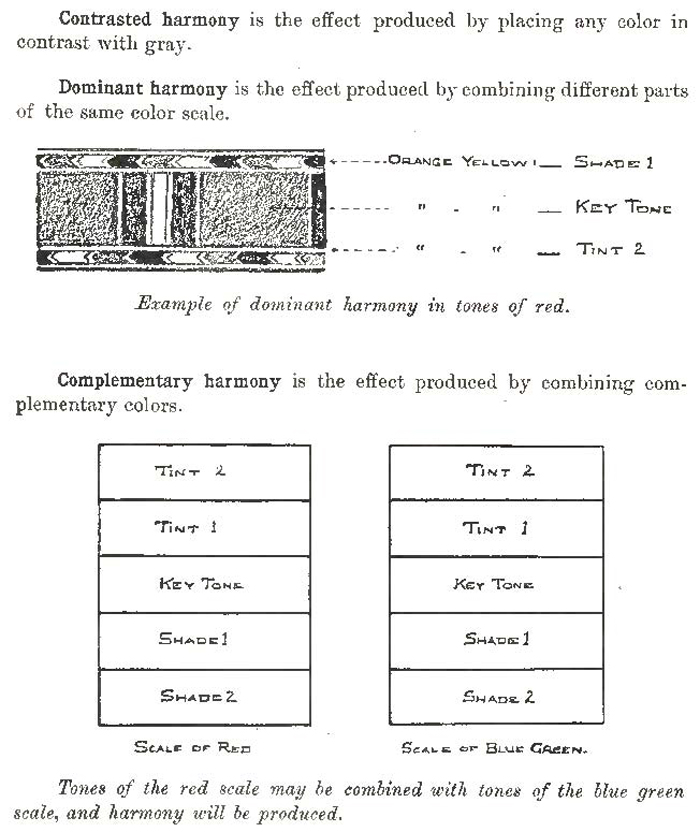
Dominant harmony is the effect produced by combining different parts of the same color scale.
Complementary harmony is the effect produced by combining complementary colors.
Tones of the red scale may be combined with tones of the blue green scale, and harmony will be produced.
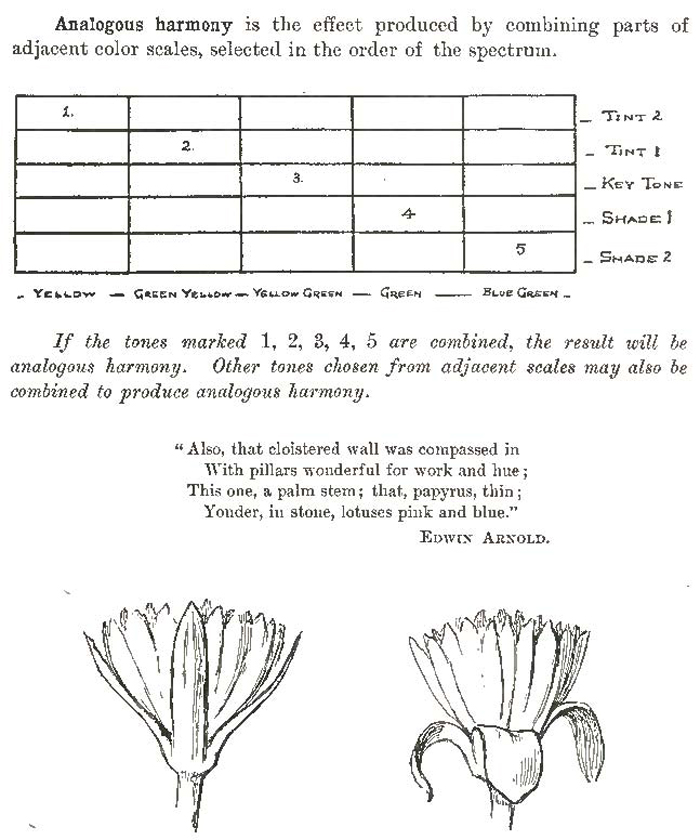
Analogous harmony is the effect produced by combining parts of adjacent color scales, selected in the order of the spectrum.
If the tones marked 1, 2, 3, 4, 5 are combined, the result will be analogous harmony. Other tones chosen from adjacent scales may also be combined to produce analogous harmony.