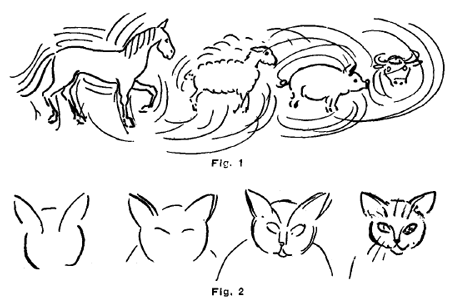
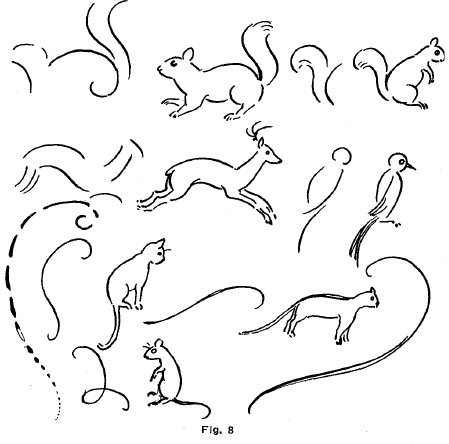
Curved Lines' are best adapted for representing the forms of animals of all kinds. It is next to impossible to find even an approximately rigid, straight line in the outline of any living animal. In fact, outside of the plumb-line sometimes formed by the spider and the horizontal line where land and sky apparently meet, Nature seldom employs a straight line.
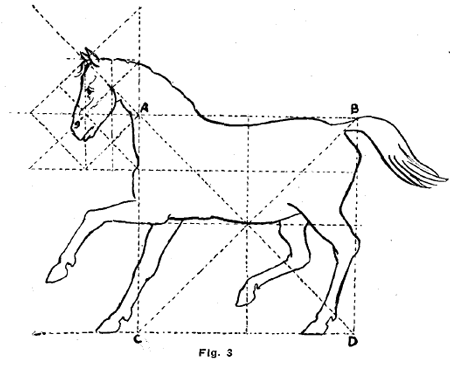
The Horse.—The body and legs of a horse viewed from the side will be found enclosed in a square space as seen in A, B, C, D, in the diagram. The added triangulation will assist in describing the proportions of the head ; the length of the head being about three-fourths of one of the four squares formed in the main square A, B, C, D. Observe a horizontal line cutting the main square in equal portions will just touch the elbow of the near fore leg.
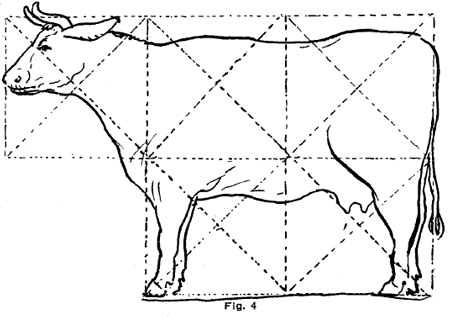
The Cow.—A square the same height as the distance from the ground to the top of the head will be found to include the body and legs. About one-half added to its width will give a parallelogram that will include the whole animal. The angles in the triangulated diagram will assist in making the drawing in correct proportions.
Dogs vary so much in breed, etc. that no exact propor- tions can be given. Examples will etc., found in the chapter on Pen Drawing that will serve as examples to copy.

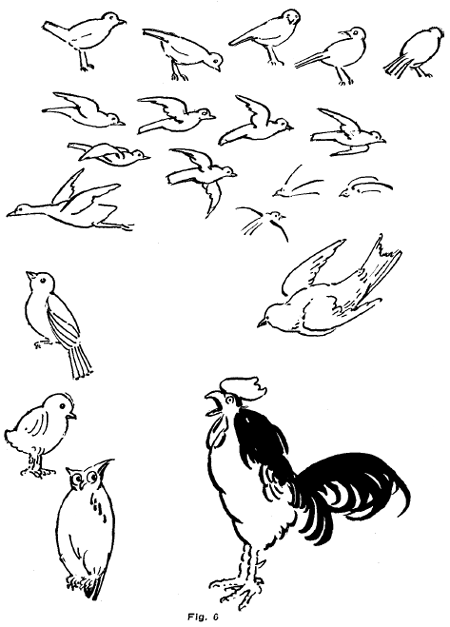
Quite as much attention is necessary to draw animals as to draw the human figure properly. Animal drawing seems to be a gift by itself that few possess. For one thing, as a rule, animals do not pose quietly. They have no sense of duty in that respect. Therefore, it is usually necessary to resort to some sort of copy in order to draw them. A photograph, however, is not always obtainable and, for the beginner, is exceedingly difficult to copy from.
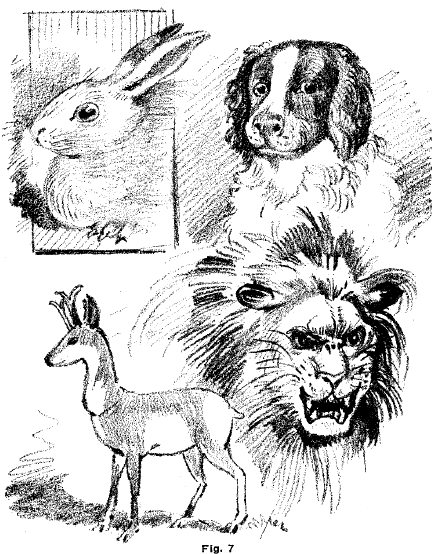
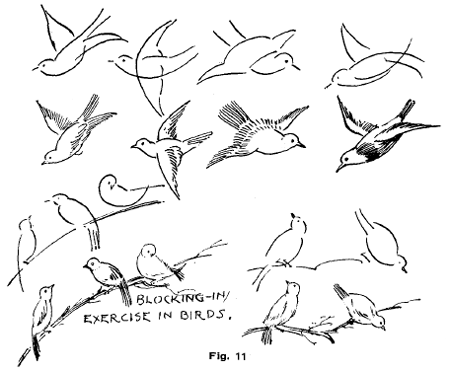
A pupil should, for this reason, be permitted to copy freely from the examples in this chapter—a chapter, by the way, that does not pretend to be a natural history.
In Shading Animals represented by drawings use delicately placed lines. Curved lines, radiating rather than paralleling, produce the best effects. Edges of shadows should blend, rather than make harsh contrasts ; in the case of a drawing of a lion, however, in order to cause the effect of fierceness. stronger gradations may be used.
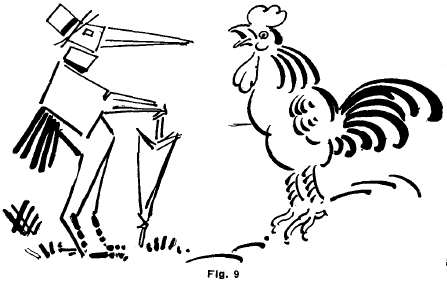
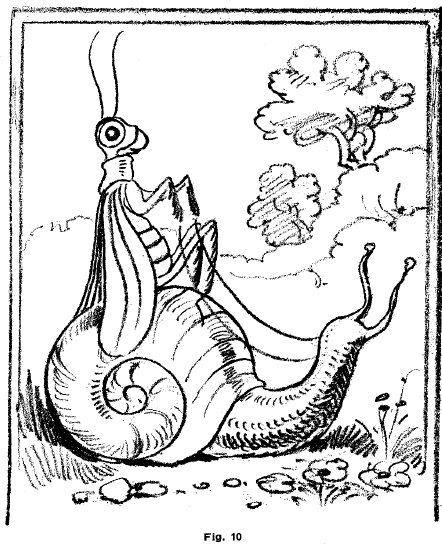
Insects and other specimens of the lower order of animal life lend themselves for pictorial display of a pleasing nature. Grasshoppers sometimes remain quiet for a long time, especially when no longer alive and, therefore, are apt to be model models. The slow-going snail presents for inspection many graceful lines, and, like some other mollusks, offers a fine opportunity for the study of the spiral in form.
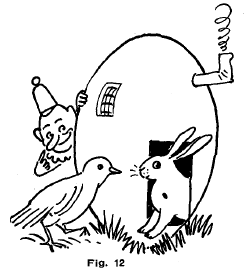
An Easter Suggestion.—A good subject for an Easter card.
Draw with very light pencil marks. Then color, and afterwards outline again but with heavier lines than before. Suggested colors: the egg, white; the rabbit, yellow; the bird, red; the imp, green, except face (pink for that) ; the sky, blue, but blending into white at the outer edges. All colors should be light; merely tints.
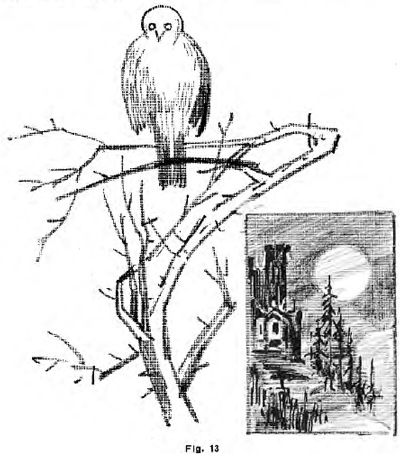
Combinations in Curved and Angular Lines are often pleasing. The curved lines in the bird, contrasting with the angular lines in the old tree top intensify the bareness of the branches, thus producing strength by contrasting effects.
In the little scene below, the round lines in the moon offset the angular lines of the tower and the trees.