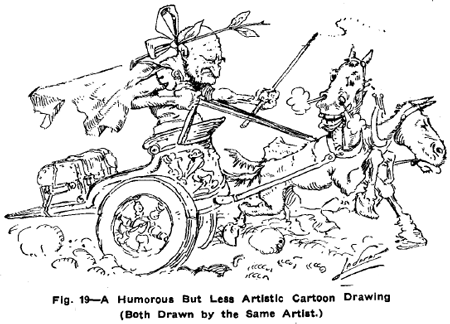
Comic Drawing.—It seems hardly necessary at this day to defend comic drawing. The comic artist has come to stay, and he is certainly one of the best paid of any profession. The Chicago Tribune in its leading editorial recently stated specifically that the cartoonists and caricaturists (which includes the limners of comic pictures generally) were the highest salaried men in the newspaper business.
Cartoonists Should Be Able to Make Serious Drawings.—Comic drawing is a study that should not be taken up to the exclusion of any other branch of art work. One great trouble with many embryo "cartoonists" is that they seem to think that they do not need to know much about the general rules of drawing to make so-called cartoons. To the contrary, the most successful cartoonists—for that seems to be the general term nowadays applied to all makers of humorous pictures—are those who are capable of making well-drawn serious drawings if required. It is as absurd to suppose that a comic artist needs only a limited knowledge of correct drawing as it would be for a writer of dialect stories to have only a slight command of properly spoken language. So the pupil with a fund of humor need not fear that he will lose it if he keeps it under subjection and confines his studies mostly to serious drawing.
To be able to draw graceful lines, to have an inkling of human anatomy, to know the fundamental laws of perspective, etc., will give him greater ability to draw side-splitting pictures later on. At the same time the pupil's tendency to draw with humorous design should not be entirely diverted or at all discouraged. The ultimate outlet for mirth-provoking drawings is so great that the artist competent to do this work well may be assured of a profitable career when he enters the field of cartooning professionally.
Expression in Comic Drawings.—The goings-on of the human mind, the internal changes, are shown in the face. Gesture of limbs and pose of body follow as if further to define the emotion. Btsides the actual expression the comic artist adds external indications. For instance, to intensify a glare, the artist projects a dotted line from the eye of the subject towards the object at which his character is glaring. The effects of a blow on the head or a heavy fall are given pictorial adjunct by means of various celestial and planetary bodies. That is to say the artist surrounds the victim with stars and comets so as to emphasize, explain and proclaim beyond the faintest shadow of a doubt that the subject is "seeing stars."
Take the emotion of fright. How often does one see a man so frightened that his hair "stands on end like quills on the fretful porcupine"? Hardly ever except in comic pictures.
Such means of forcing the effect may not mean art, even of a low order, but it saves the onlooker (especially if he can not read) from wear and tear of the brain. The "cross-showsthe-spot" style of comic picture seems to have come to stay —for a while at least, and therefore is worthy of attention if not respectful consideration.
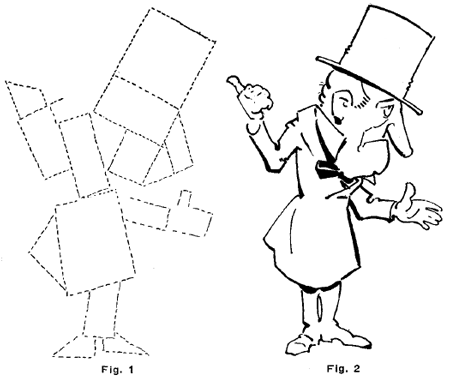
For exercise, block in some of the other figures according to the manner shown in Fig. 1, 2 and 3.
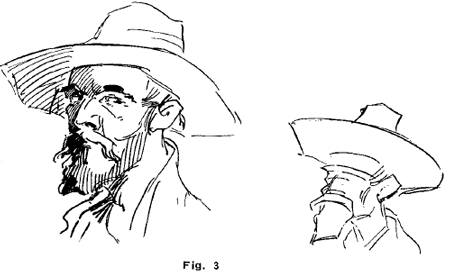
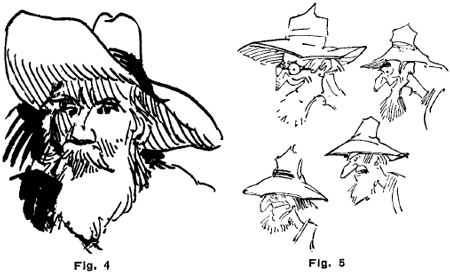
Fig. 3 was drawn with blocking-in lines and Fig. 4 without them. Which looks the better ?
Young Americans, on the average, take naturally to action and humor, rather than to mere form for form's sake. They are more apt .to take to the practical side of things than the sentimental. It should be the endeavor of the teacher to arouse interest in the subject, even though the ideal and the beautiful be subjected to temporary obscurity.
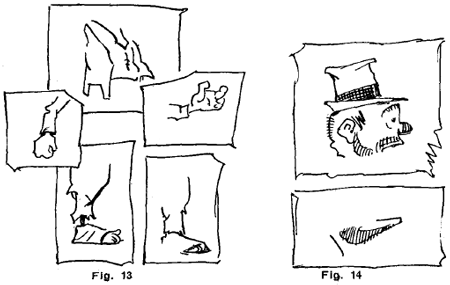
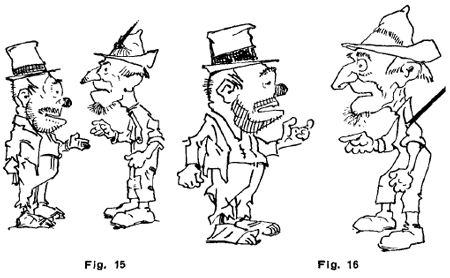
For exercise draw parts of the figures and arrange the figures in different poses.
Blocking-in is as necessary for comic drawing as'any other. The upper right-hand head was drawn without block-- ing-in. Note the difference.
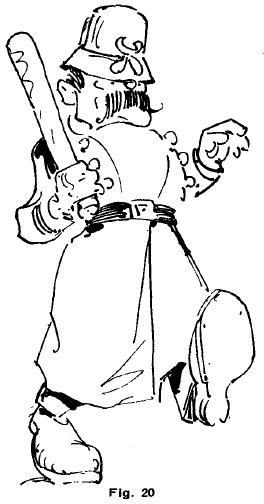
The comic figure of the policeman (Fig. 20) is an instance of 'head and feet distortion. The body and hands being nearly normal in their proportions.
The same sketch is shown on page 257, on Lettering, Initials and Book Covers, adapted to a comic book cover. And in the chapter on Elements of Perspective it appears repeatedly in connection with the subject of atmospheric perspective.
Indulge and stimulate to a sensible extent, the child's natural sense of humor. Allow him to give free reign to his imagination, but strive to define, direct and correct the images that he conveys upon slate, paper or blackboard.