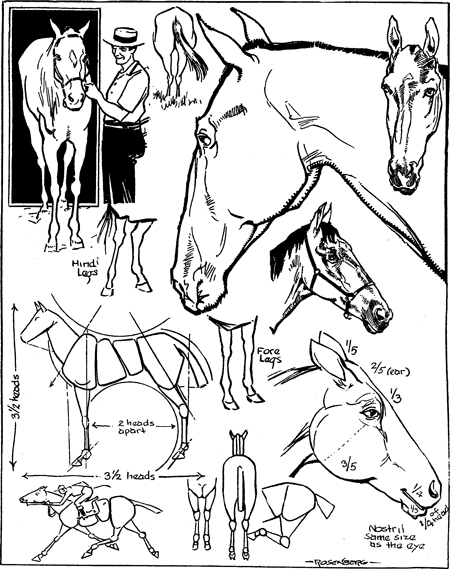
Method of blocking in a horse, with measurements.
A STUDY OF ANIMAL ANATOMY : Simple Methods of Drawing
The newspaper artist, owing to the variety of assignments which he is given, and the wide range of duties which his position entails, has frequent occasion to draw domestic and other animals—as when the circus comes to town, or a dog or cat show is held. For this reason he should have at his command simple methods of drawing that will enable him to work rapidly, yet accurately.
Among the most difficult animals to draw is the horse, wherefore, to aid the student in achieving deftness in putting this important animal on paper, I have evolved a simple technique.
A horse, if you will observe carefully, is built up of triangular blocks—though irregular, yet in general shape they are triangular, each triangle fitting to the next, as shown in the illustration herewith—a triangle for the head; two smaller triangles for the ears (two-fifths of the head size) ; a triangle for the neck; one triangle for the shoulder (narrow point at the top) ; a triangle for the ribs ; a triangle for the abdomen; a triangle (point downwards) for the flanks; a triangle for the tail ( cut short), and a triangle for the upper legs. The knee takes on an oval shape; the lower leg is an "I" shaped triangle, with another "0," or circle shape, for the ankle, and a triangle below, to which is attached the hoof, which forms another triangle.
After making these triangles, which should require but a minute or more, with practice, swing a circle down the top and between the legs—front and back—and keep within that circle. The back knee should be on a vertical line with the farthest point of the pelvis (whence the tail protrudes). The tail, falling vertically, makes a triangle-shaped space between the back of the pelvis and the back of the upper leg. Another triangle is made between the jaw line and the neck line, when a line is drawn from the chin to the lower neck connection with the shoulder angle.
A third triangle is created where the abdomen and upper leg face each other.
The shoulder bone is a diagonal. Dropping a vertical line from the top thereof, the foreleg is placed in line. The forepoint of the hoof is on a vertical line with the foremost point of the chest. The hind leg is on an opposite angle to that of the shoulder blade line. The forepoint of this hoof is on a vertical line with the highest point of the buttock.
The horse is ideally three and a half heads high, and three and a half heads long. The legs are one and a half times the depth of the body at the shoulder. At the widest point, the knees, the legs are two heads apart.
The head measurements follow: the ears, 2/5 in length, cropping out at 1/5 below the top. At 1/3 the eye is placed, 1/3 within the head line. The eye is full view on A profile head. The mouth is 1/4 the head length and is 1/3 up from the chin. The jaw circle base will be diagonally opposite the eye. The upper jaw line will be on a horizontal line with the upper eyelid. The semi-circular jaw bone line will be 3/5 the head.
The nostril will measure 1/3 of the lower front of the head, which is in size 1/4 the length of the head. At the widest depth (the jaw) the head will measure half the length.
Method of blocking in a horse, with measurements.
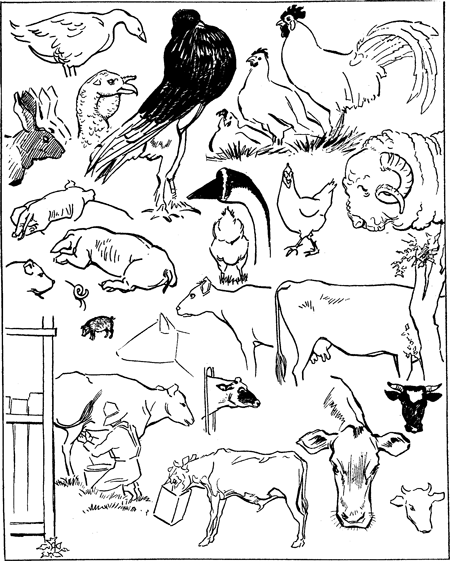
Some common barnyard folks.
In animal as in human life, the male is usually more heavily built than the female. This is clearly in evidence in the case of the cow and the bull.
The bull is a heavy animal, massively constructed, short and stocky in proportions. The neck, as contrasted with the female, is short and broad. The female is longer and slenderer. Massiveness of chest, legs, torso and head in the bull are lacking in the more slender lineaments of the cow (see page 58).
The bull may be best remembered and drawn as follows : the head is a short triangle. The neck (triangle) is half the width of the head; the body is an oblong; the chest about half the length of the body; the distance from the base of the body to the ground line is a little over half the depth of the chest. The fore line of the chest drops down from the inner point of the jaw. The shoulder blade forms a letter "L," slightly tilted downward. The legs are formed by three triangles—the largest for the upper portion, which tapers down and meets the second triangle, which starts narrow and widens to the point where it joins the hoof. It is half the size of the upper portion, and the hoof is half the size of the lower portion. The forechest line is lower than the nether body line. The tail, including the whisk of hair in which it ends, reaches below the back knee hock, and drops in a straight line from the top of the buttocks.
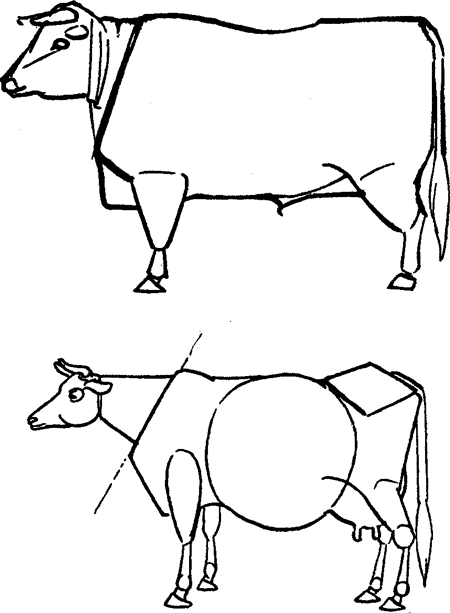
Blocking-in lines for bull and cow.
The cow is built similarly to the bull, an important point of difference being that in the case of the cow the pelvic blade (buttock) is more prominent, especially in the case of a lean cow.
In the case of the canary and similar small birds, anatomical construction can be easily assembled and developed by laying them out as follows:
For the head, use a small circle; a small triangle to suggest the bill; a "shoe-button" dot for the eye; and an egg-shaped outline for the body, the broad end attached to the circle made for the head. For the wings, the capital letter "J," lying
on its stem, may be used. An irregular triangle is then made to run in line with the back (the upper egg line) ; a triangle is made for the upper portion of the leg, and a line for the lower, with four "C" shaped toes when the bird is sitting on a branch.
This is the simple method used by prehistoric man, and still serves as a splendid aid to quick drawing.
THE MULE
The mule is built similarly to the horse, and to have learned to draw the horse will enable you to draw the mule without difficulty. The chief difference between the head of the horse and that of the mule is in the length of the ear, and in the fact that the horse has a longer neck and a longer body.
The mule has long ears that come to a point. Ordinarily they reach out at a slightly diagonal angle. When the beast becomes angry, or suspects danger, he turns his ears straight up, the hollow of the ear forward, the better to catch the sound of danger. Also, his mane is more of a stubble, than the flowing, wavy mane of the horse. When he is asleep his ears droop to a horizontal position.
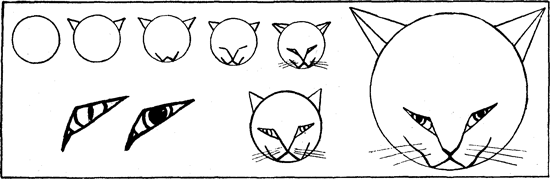
Showing the various steps in blocking in a cat's head.

The cat is made in similar manner to the other domestic animals. For the main part of the body make a letter "0." Then for the shoulder draw a "C" and for the front leg a letter "I." In practising drawing cats, try to catch them when they are at leisure.
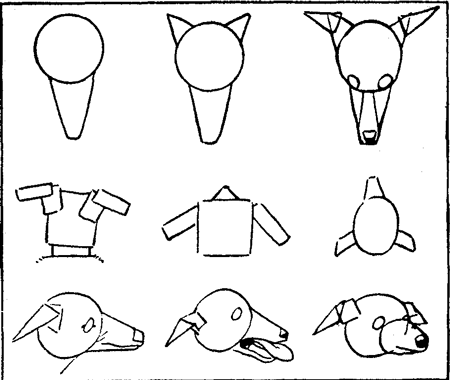
The dog is blocked in similarly to other domestic animals. The above cut illustrates simple steps in evolving the head.
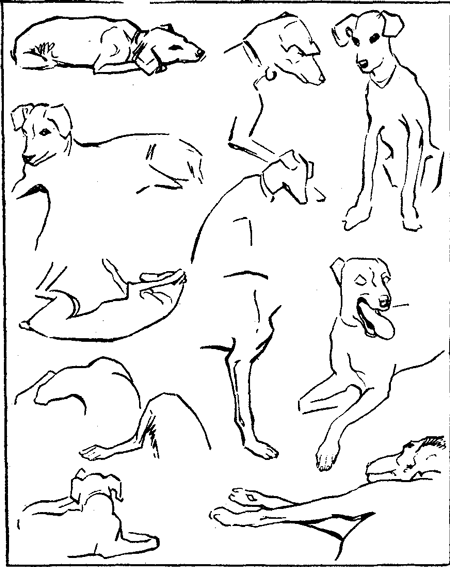
Some action and rest poses of the dog.
THE ELEPHANT
The ungainly looking elephant, perhaps the most caricatured of all the animals, may be easily constructed by the following method : for the head use a circle ; attach thereto, for the torso, a large letter 0," lying on its side. Beneath either end of the "0" place two oblong squares, or broad I" shapes, flattened at the base to suggest the hoofs. Attach to the circle for the head a long letter "J" to represent the trunk—broad at the head and tapering towards the base.
For the chin, a small triangle below the trunk may be used. If tusks are shown they emit from between the chin and the trunk—in other words from the corners of the mouth. The ear is large and fan shaped—a sort of irregular triangle, the broader end diagonal towards the chest. The tail is comparatively short, tapering to the end, which reaches to a line above or even with the lower part of the torso. The eye is small and placed about the center of the head—a bit in from the edge —and deep set.
The elephant is a wrinkled individual, particularly the trunk, which rolls in a series of wrinkles. Wrinkle lines at the leg joints and the nether part of the torso are more prominent, while the tail is wrinkle lined.
Most elephants have a bump on a line with the eye, which is the beginning of the trunk.
THE LION
The lion is powerfully constructed, somewhat in the form of the cat—having rather a more slender body than the cat. The male lion, too, has a mane that crops out above his forehead and back of the ears, covering the neck. It forms a hood shape about the head. The head is more angular, narrowing to the front. The body on the whole is narrow and slender; the forepart is strong and massive in appearance, the pelvis very narrow. The tail is long and smooth with a whisk of hair at the end, like a water-color paint brush. This tale is about equal to the length of the torso. The paws are large and puffy, with five claws in front and four on the hind legs.
The female lion is practically the same in anatomy as the male, excepting that the female never has a mane. She resembles the puma, and the mountain wild cat or mountain lion, which is another name for that animal.
THE MOUSE
The mouse, so popular in present-day comics, can be easily drawn by using a triangle for the head, two small "0" shapes for the ears, atop the triangle, a letter "0" lying lengthwise, about three times the size of the triangle, for the body, a dot for the eye—a shoe-button dot, with a high light in the center when you are making a large drawing, and a few long whiskers. Thin legs should be added, bent, inasmuch as the body is close to the ground. Add long fingers to the feet, with a long, thin, tapering tail, about as long as or longer than the body.
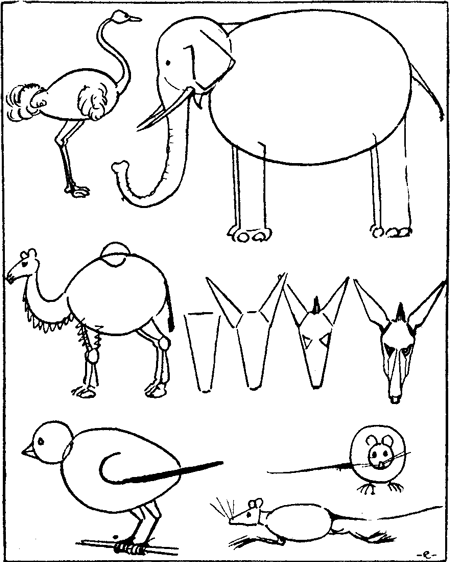
Simple methods for blocking in some well-known
animals.
BARNYARD ANIMALS
The secret of sketching barnyard animals is to use few lines and avoid details. The sketches shown on page 55 were drawn, some of them, at a poultry show in Cincinnati, some on an Ohio farm, the pigs in West Virginia, and the calf with his head in a lard can on an Arizona ranch.
Always in drawing an animal observe the form as it will look in blocks — as suggested by the block of the cow's head in the lower center of the plate. The block method is an easy way to draw a cow and get it proportionately correct.
On the large leghorn rooster in the plate the breast shadow is suggested by a heavy line. The red comb is made solid black rather than try to denote that dark color by means of lines.
Too much emphasis cannot be laid on a thorough study of the skeleton and anatomy as a preliminary to drawing animals of all kinds. Having a dog or cat in the house will also afford good opportunity to study animals from life. Observe how the bones bend in their different poses; the positions which the legs assume in sitting, running, jumping, etc. When you draw a cat or a dog in action, or any animal of similar type, you will then be better able to put true pictures of life in the desired actions.
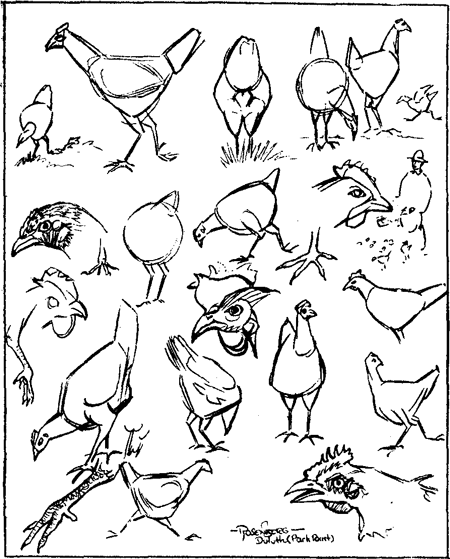
The blocking-in method as applied to chickens.