Without the knowledge of perspective, constructive
drawing is impossible. Leonardo Da Vinci called it the
"bridle and rudder of painting." Every form, from a grain
of sand to a mountain, exists in perspective. It is the first
thing a student must learn. Like the alphabet in a language,
without it, one would not be able to write. Too many stu-
dents by-pass this phase of learning. The knowledge of per-
spective makes it possible to create the illusion that objects
and figures are three dimensional on a two dimensional
surface such as a sheet of paper, canvas or wall.
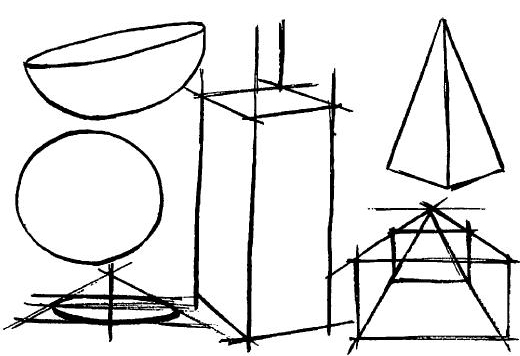
There are three basic forms in nature: the square, the
circle and the pyramid. Every object fits into these three
shapes or a modification of them. The square can be a cigar
box or a sky scraper, or any form with six sides. The circle or
sphere can be a pea, an observation balloon or a wheel.
The pyramid can be a church steeple or the pyramids of
Egypt.
The muscles of the human figure can be put into any of
these shapes. Knowing the names of the muscles and bones
is not sufficient knowledge to draw the figure. If this were so,
every good doctor would be able to draw the human figure.
One must know the shape of the parts of the body and be
able to put them in perspective.
The mere copying of anatomical drawings will not
teach one to draw the figure or to create one without the
model. There is no other field of study in which students fail
in greater proportion than in art, because of by-passing the
study of perspective. Its importance cannot be over-stressed.
Every great painter understood its laws.
In the following pages I have. tried to show a simple
approach to the subject.
With the knowledge of a few simple squares such as a
radio, a match box and a package of cigarettes put together
becomes a group of buildings. As shown on Page 9, Page 12
and Page 13 two photographs of a shipping department are
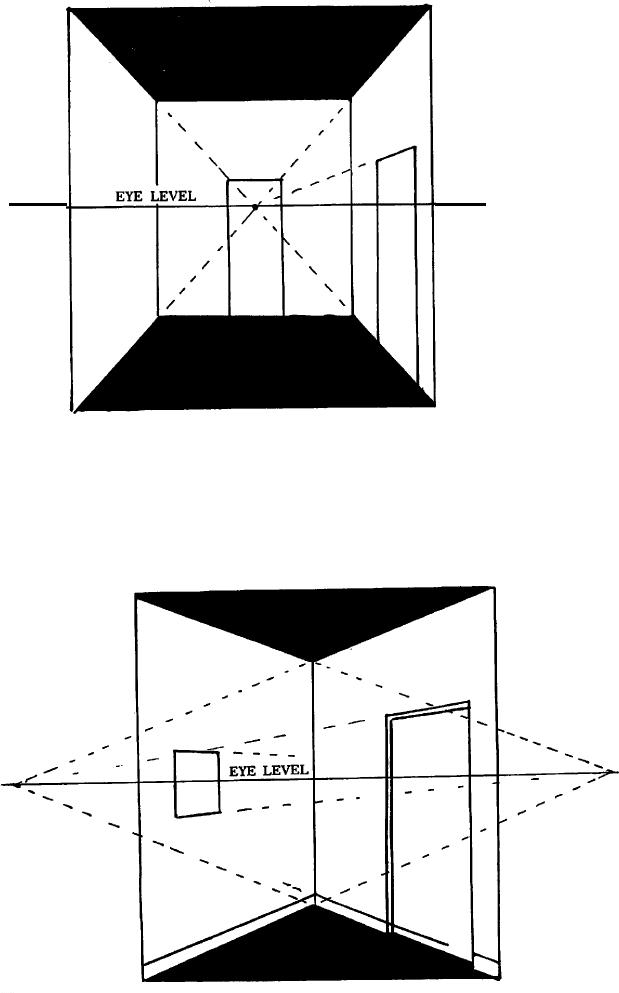
changed into two cities. The interior of a room is nothing
more than looking into a box. If one is able to draw a tube
in perspective, it becomes simple to understand the fore-
shortening of arms and legs of the human figure.
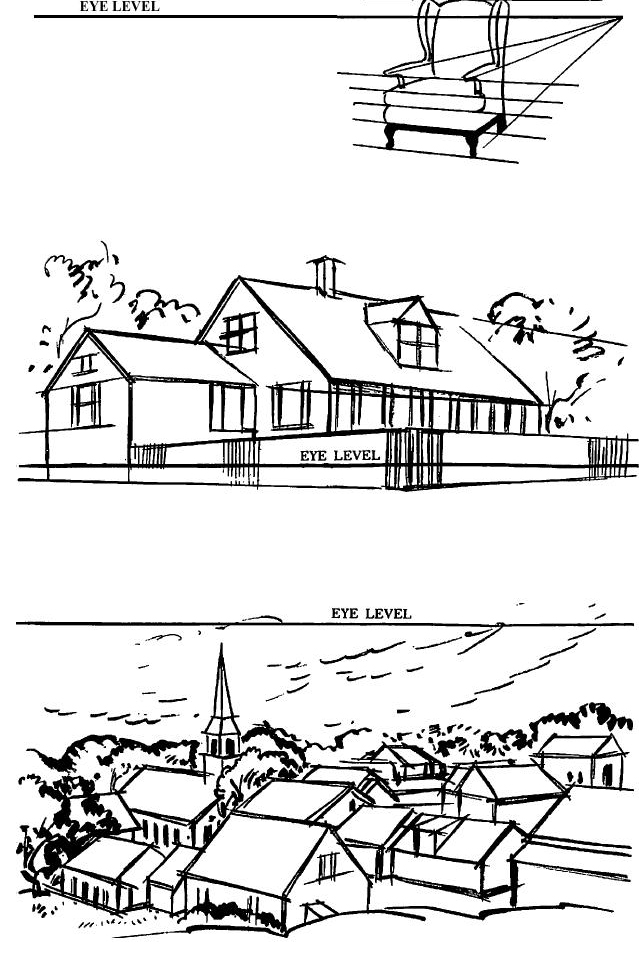
When beginning a drawing or picture, first establish
your eye level by drawing a line across your paper. It will
correspond to the level of your eyes in relationship with
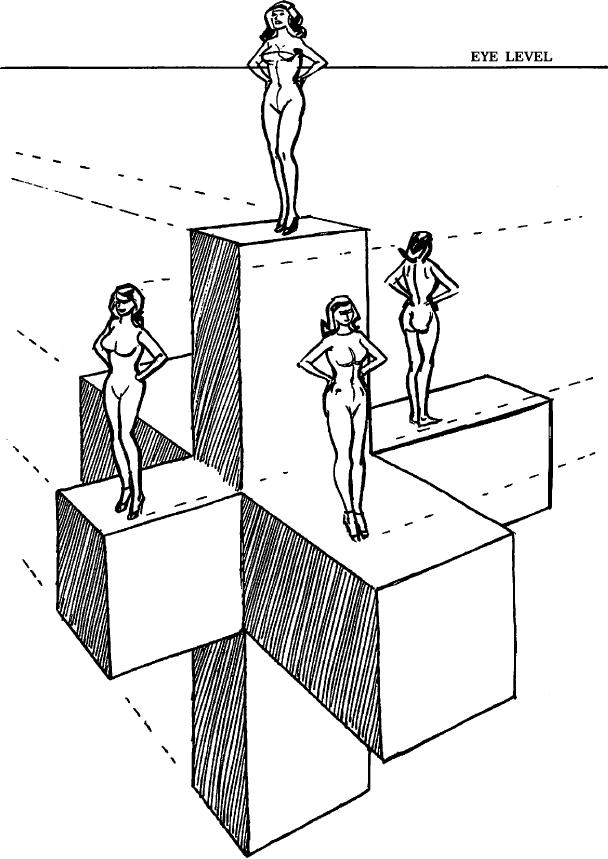
the object or scene that you are drawing. For example, if
you are sitting in a chair drawing a model who is standing
in front of you, the level of your eyes will be at about the
waist of the model. Every form above the eye level will
recede downward to the eye level and every part of the
model below the level of your eyes will extend upward to
the eye level.
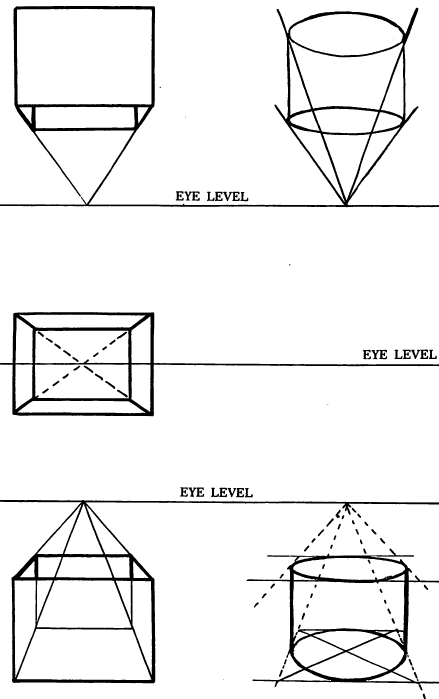
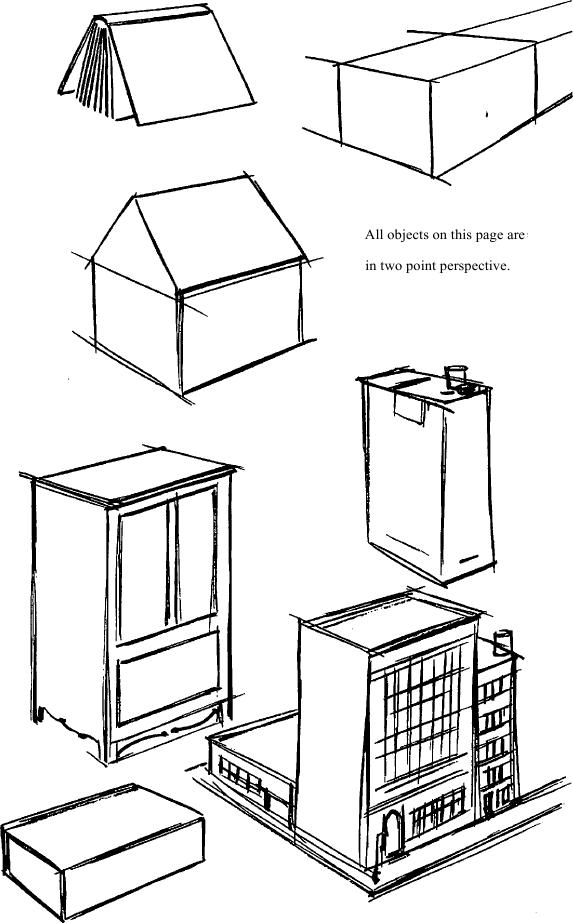
Apply these principles to any square object around you. Place a book in
front of you without being able to see the sides but just the front and top and
draw it using one point perspective. Try it with a table or chair or any six-sided
square, then turn the same objects so you can see three sides -- front, side, top
using two point perspective.