Page : 1 2
Nature is beautiful … take some time to just stare at its beauty. All of nature’s beautiful items, such as trees, mountains, hills, leaves, flowers, etc, can be broken down into simpler shapes. Try not to upset yourself with the huge amount of details that you see in a tree, but try to instead, break trees down into simpler shapes that you see….such as ovals, lines, and cylinders. After reading this article, you will feel a lot more confident in drawing trees.
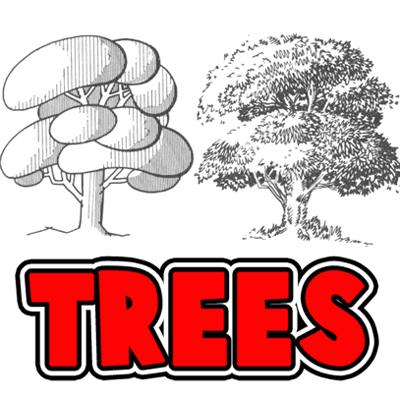
An artist must discipline himself to be observant. Through experience, he learns to see in objects which are unfamiliar to him, related shapes which are familiar to him. Through this interrelating and comparison of forms, drawing problems become more simplified. Observe, in the above illustration, the comparison of the various tree shapes to that of geometric solids. Note that in the upper right-hand panel is shown the silhouettes of a number of trees. The character of a tree may be determined by its
silhouette.
When sketching outdoors, a student will at first find it easier to draw a tree which is at a distance, rather than one which is near. This procedure simplifies many of the problems of detail, lighting, etc Before starting to draw, analyze the shape and proportions of the tree. Determine the light source and its shadow areas. Study carefully the contour and character of the subject.
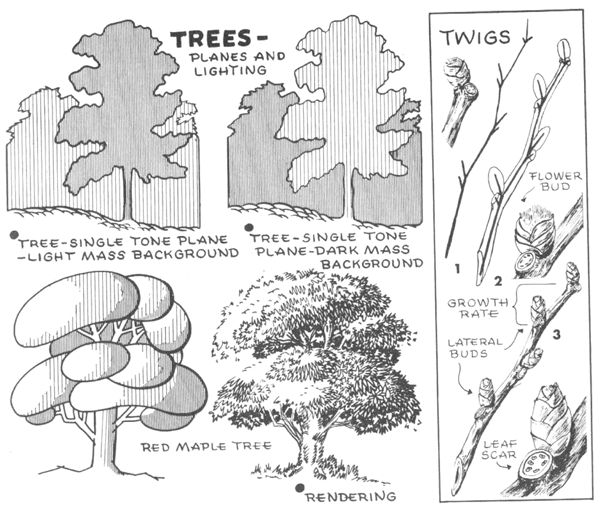
DRAWING TREES (PLANES AND LIGHTING) :
When studying a tree determine its tone value in relationship to its background. Ask yourself whether the subject is darker or lighter than the mass behind it. On a clear day, if the sun is not too bright, the tree may show only one phase of tone against a lighter single-tone background. This is particularly true if the tree is at a distance. Sometimes, the tree will appear lighter than the background.
Observe in the lower left-hand corner of the above illustration that the various foliage masses have been divided into simple oval shapes. Too, that the high light and half-tone areas have been blocked in simple tonal planes. This basic construction will serve as a framework in rendering the foliage of your tree.
To draw a twig, note the basic steps illustrated in 1, 2, and 3 above. When studying a twig, observe the arrangement of the buds. Note the leaf scars at the end of each section and their relationship to the buds. The bud at the tip of the twig is known as the terminal or head bud. The buds below are termed lateral buds. Each new bud has a leaf scar directly below and at the end of each growth section.
[ad#draw]
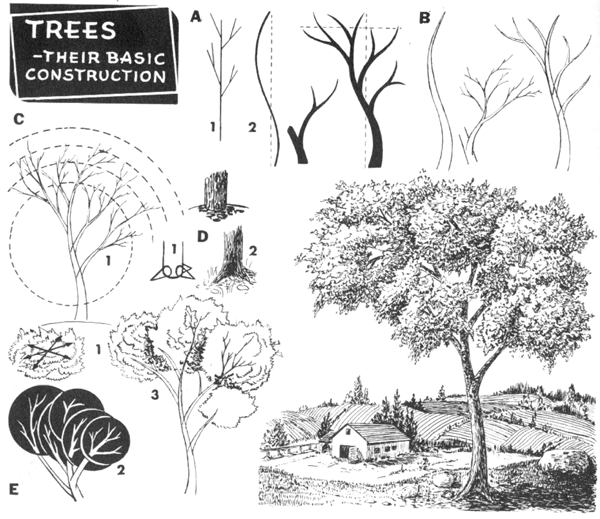
DRAWING TREES (STEPS IN CONSTRUCTION)
Illustrated in Figure A, #1 (above) you will see a stiff vertical skeleton of a tree. Now note the rhythm afforded by the curved line in No. 2. This latter line is termed the action line. Such a curved line is flowing and will give your tree more grace. and interest. In interpreting a subject, an artist need not be photographic liberties may be taken which he feels will make his work more exciting.
Fig. B demonstrates the basic construction of the tree trunk and limbs, through the use of action lines. In Fig. C, observe how the lengths of the limbs and twigs have been based on a weight of the limbs have been placed within the circle (No. 1).
In Fig. D, No. 1, is shown a simplified method for establishing the roots. One should not merely place a tree trunk in the ground as if it were a pole. but should root it into the ground as shown in No. 2.
Observe in Fig. E, No. 1, that the foliage radiates in various directions. No. 2 illustrates the foliage masses to be defined, within a series of circles. In No. 3 is seen the start of sketching in the foliage on the tree skeleton.
To Continue With this Article, Please Click on Next Page in Link Below
Page : 1 2
Pages: 1 2
beautiful. thank you for sharing!
THANK U, PLEASE SEND MORE BASICS FOR DRAWING, LEARNERS STAGE
i really liked the old cartoon-y “how-to” look of the images. Very period-authentic. Were they by the author or from an old book (and if so which one)?
This helped me SOO much on my drawing.
Awesome thanks for the tips
really cool!!!!